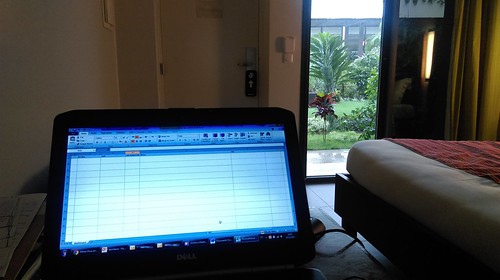
I finally passed the PMP exam! And what is this photo? That was in Bamako, Mali, I was stuck at the hotel as it was pouring rain outside. And then I got into that moment where I told myself that's it, I am not postponing the PMP exam anymore, I will register for the exam right now.
This could be a long post, but I tried to write all the lessons I learned, anyway there are no shortcuts to the PMP certificate, good luck!
about the exam
It consists of 200 multiple choice questions and you have 4 hours to finish the exam. If you have a university degree, you are eligible to sit for the exam if you have:
- 3 years of project management experience (4,500 hours)
- 35 hours of project management education obtained through (physically) attending a course in a center or taking an online course.
You can register for the exam (total cost is $544) through this link:
In you application you should provide a 550 character description (yes 550 characters, not 550 words) about each project that you worked on. You can download a useful template from this link which will help you fill your application.
Some applications are selected randomly for an audit process, it happened with me. If it happens with you too, don't worry I put some useful details at the bottom of this post.
preparing for the exam
I studied from two books:
How much time did it take me? I would say over a year, but I was studying in a part time mode. Most importantly:
I tried to take a break for every 50 questions (5-10 minutes), close your eyes and take a deep breath in this short break. I was aiming to take 30-40 minutes for each group of 50 questions. It is easy to benchmark using 50 questions, 200 questions are four 50-question groups.
In you application you should provide a 550 character description (yes 550 characters, not 550 words) about each project that you worked on. You can download a useful template from this link which will help you fill your application.
Some applications are selected randomly for an audit process, it happened with me. If it happens with you too, don't worry I put some useful details at the bottom of this post.
preparing for the exam
I studied from two books:
- The PMBOK, 5th edition pdf (13 chapters)
- PMP Exam Prep, 8th edition by Rita Mulcahy (15 chapters)
- useful youtube channel: www.youtube.com/user/izenbridge
- useful twitter user: twitter.com/PMExamTips
First step: I highly recommend you start by fully reading Rita's book. Keep in mind that you may find the first three chapters a bit too abstract, it is ok, they will make sense as you move on.
Second step: After you are done with Rita's book for the first time, you have to read Rita's book again in parallel with the PMBOK (chapter by chapter), and this time try to summarize the main points which will help you keep the knowledge in your mind. By now you should be able to easily write down the breakdown of the 47 project management processes.
Third step: I did not solve thousands of questions, I just solved the questions at the end of each chapter in Rita's book. It was a frustrating process because I made many mistakes, but mistakes help you identify gaps in your knowledge. And last week before the exam, I did two mock exams using the Fast Track software, which helped me simulate the actual atmosphere of the exam.
How much time did it take me? I would say over a year, but I was studying in a part time mode. Most importantly:
- Try to build daily momentum, try to study 5 times a week (every working day). If you can't put yourself in a 3-hour slot, do three 1-hour slots a day. I don't know, find a solution (before work, after work, during lunch break..)
- Registering for the exam made me put serious efforts because of the firm deadline (my story above in Bamako). You have one year to take the exam and you can reschedule for free if the exam is more than 30 days away, rescheduling within a month would cost you $70. If you do not feel so confident, there is nothing wrong about paying these $70 (I did myself), still feels better than to failing the exam.
- After you finish reading Rita for the first time, your exam should be (maximum) within two months, if you take your time you will start to forget the parts you studied at the beginning.
Rita first time: 15 chapters x 3 days each = 45 days
Rita second time: 15 chapters x 2 days each = 30 days
PMBOK in parallel: 13 chapters x 1 day each = 13 days
Two mock exams = 2 days
Total would be 90 days (so ~126 calendar days)
Rita second time: 15 chapters x 2 days each = 30 days
PMBOK in parallel: 13 chapters x 1 day each = 13 days
Two mock exams = 2 days
Total would be 90 days (so ~126 calendar days)
strategy for the exam
You have some extra time before the exam starts, use it to write down the 47 processes (or anything that you might forget) on the papers you have. You also have a calculator, so don't worry about being good at math.I tried to take a break for every 50 questions (5-10 minutes), close your eyes and take a deep breath in this short break. I was aiming to take 30-40 minutes for each group of 50 questions. It is easy to benchmark using 50 questions, 200 questions are four 50-question groups.
Last but not least, don't wait for the perfect circumstances to do the exam, be prepared to study anywhere (your room , library, kitchen, airport, plane..), even though I passed the exam I can admit that I was not fully prepared.
bonus: about the audit process
When you are selected for an audit, you will receive an email with forms containing details about the projects you submitted in your application.
You print each form and give it to the boss specified in the application for that project (if the previous boss is not available you can give it to the current boss who is familiar with this project). Then he/she has to sign it to validate the details you wrote, put it in a sealed envelope without you seeing what they wrote, and writing their name initials over the front edge of the envelope.
You then collect these envelopes and put them in one big envelope and send them to PMI by mail.
When you are selected for an audit, you will receive an email with forms containing details about the projects you submitted in your application.
You print each form and give it to the boss specified in the application for that project (if the previous boss is not available you can give it to the current boss who is familiar with this project). Then he/she has to sign it to validate the details you wrote, put it in a sealed envelope without you seeing what they wrote, and writing their name initials over the front edge of the envelope.
You then collect these envelopes and put them in one big envelope and send them to PMI by mail.


