Showing posts with label Strategy. Show all posts

Thursday, May 4, 2017

How to get from first circle rainbow street to weibdeh in 3 easy steps (and less than 1 jd): using Sarvice

Often during the lunch break I go for a quest, trying to utilize one hour for something useful. Lately I also discovered some public transportation routes (have a look on this nice public transportation initiative http://maannasel.net/map/mapinstructions/ )

So at first I thought, just like it was interesting for me to know how to get from Jabal Amman to Weibdeh using public transportation, maybe it would be interesting for someone else to know this too, and in this case I need to put this knowledge over the internet, typically through my blog. Then I remembered ok I need to take pictures then go and use my laptop, soon this will turn into a weekend project, but take a moment to feel the discomfort of simplifying things, why to overkill it? The answer was why not to use twitter?

I quickly went to the first circle took the picture and took the Sarvice to downtown, and from there I took another picture of the other Sarvice that takes you to Weibdeh. Then I realized that taking the picture of the parking spot of Sarvice cars going to Weibdeh will be sufficient, in this case I won't need to spend time to go to Weibdeh. For some reason it was off my head, this is again about the difference between theory and practice.

While drinking a cup of espresso, I used my mobile to edit the pictures with handwritten instructions, they were not perfect but I am sure they are there on the internet changing someone's life at least weeks before I get semi-perfect circumstances, because I will never get to the perfect circumstances point. Don't waste your life waiting for perfect circumstances.

Monday, June 30, 2014

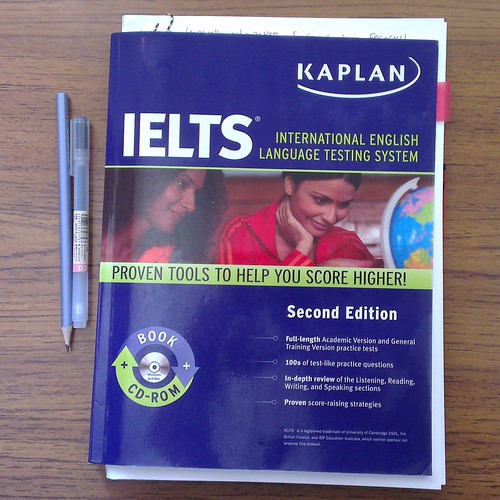
How to Get a Band 7 in the IELTS Exam


IELTS by Kaplan
Fresh from the oven!
Finally, after three trials I got a band 7 in the General Training IELTS exam. I thought of sharing some useful tips, which are put below in the same order of the different parts of the exam (If you are taking the TOEFL, click here).
Speaking
Be calm and confident, just as if you are having a normal conversation with a friend. The second part is the toughest as the minute you spend on preparing your answer goes too fast while talking for two minutes seems to take a very long time.
If you have the option, do the Speaking test on a different day and remember that you don't get extra points for the accent. It is also useful to memorize some fillers to use them in case you run out of words (ex. that's a good question, let me think, I cannot find the word for that ..). Finally, take a deep breath when you get confused and as the examiner is asking the question.

Listening
Focus, focus and focus! As you proceed towards the last section, the speed of the conversation increases and you have more blanks to fill. If you miss one blank proceed directly to the next one, otherwise you might mess more blanks.
The narrator spends time explaining the task before the actual exam, you can utilize this idle time to read the questions and try to predict the answers, especially for the last section. Silly mistakes could happen as well, I once made a mistake in copying my answers to the answer sheet, please don't do that.

Reading
The trick about this part is to read the questions first then move to skim the passages for the answers, otherwise if you start by reading the whole passages you will run out of time. The good thing about the Reading exam is that the questions come in the same order of the passages, though the bad thing is it is a bit tougher than the Listening section (a mistake here costs half a mark, while in Listening 3 mistakes still get you 8.5).

Writing
In my opinion, this is the dullest part of the exam, I had to repeat the exam for the third time because I was short of 0.5 mark in the Speaking exam and all the extra effort I put hardly got me to 7. The two parts of this section are mentioned below, in both cases word count is important, but exceeding the word count does not mean points will be deducted.
* A Letter (150 words)
Spend 5 minutes to prepare (read, brainstorm & plan), 10 to draft and 5 to review. You have to explicitly address the objectives of the question. As for the salutation:
- a formal message, name of recipient is unknown: Yours faithfully
- a formal message, name of recipient is known: Yours sincerely
- an informal message: regards
* An Essay (250 words)
Spend 10 minutes to prepare (read, brainstorm & plan), 20 to draft and 10 to review. When brainstorming, write at least four points on each side and in terms of the structure:
- introduction, just rephrase the question
- write "on the one hand" followed by a paragraph containing the side you argue with
- write "on the other hand" followed by a paragraph having the side you support
- write "in conclusion" followed by concluding paragraph, which should clearly mention your opinion

I read somewhere that even a native English speaker could fail this exam, therefore, doing more mock exams enhances your chance of getting a very good result. This book was useful although I had higher expectations about its content (ex. it has some trivial typos: "you might makes" on page 143). Good luck!

Saturday, August 31, 2013

About Strategy

Chewing Gum
In continuation to my other posts which make a huge impact on other people's lives (this is a joke, but could be true though) I decided to blog today about Porter's Strategies and then realized that the chewing gum example would be a very good one to help me explain about this. The picture above shows two different brands of chewing gum:
  • Trident is sold for 60 piasters and has 10 pieces, so each piece is for 6 piasters
  • 'Shaarawi' is sold for 1 piaster and has 2 pieces, so each piece is for half a piaster
To some extent, both brands do the same function, yet relatively speaking, there is a huge difference between the two prices and both products are still in demand, is this justifiable? This is because each of these two products has a different strategic direction. From Porter's point of view, a strategy could follow any of two main directions; either Low Cost or Differentiation, the third option would be a Hybrid approach that is somewhat between the two.

Hence, in this example, 'Shaarawi' offers a very basic product but for the lowest price among its competitors. On the other hand, Trident's offering has been differentiated by promoting additional features such as a long lasting flavor, a sugar-free product plus a more appealing package which could have implications about the quality; from a consumer's point of view this justifies the price difference. Usually, when a new player joins an existing market it utilizes a Low Cost strategy to gain market share.

Porter's Strategies are not only restricted to business. For instance, a job applicant with a Differentiation approach would try to increase the likelihood of having a better paying job through emphasizing how different he/she is; including a solid list of qualifications or a background of voluntary work and extracurricular activities. Conversely, the applicant would try to secure the opportunity and settle for a very basic salary in case of a Low Cost direction.

One last thing, have you considered how a product being sold for 1 piaster manages to cover manufacturing cost and still has a profit margin?!

* Reference: Johnson, G., Whittington, R., & Scholes, K. (2011). Exploring Strategy: Text & Cases (9th Edition ed.) Harlow: Pearson.

Wednesday, October 24, 2012

Absorption Costing

Hurry Up Royal Jordanian!

I recently realized that when we travel, what we go through could actually explain the difference between fixed cost and variable cost;
  • Fixed cost would be the plane ticket, which is the same for the whole trip no matter how many days we spend abroad
  • Variable cost could be our hotel expenses, which would vary according to how many days we stay there
If one is calculate the cost of the trip per day, one method would be to absorb the fixed cost into the total cost; i.e. you add both fixed cost and total variable cost and then divide the result by the number of days for the journey and voila you will get one number that represents cost per day. This implies that if you are already visiting a distant destination, it would be a good idea to explore a couple of nearby destinations as you have already incurred the fixed cost.

However, the thing that I realized was that cost does not have to always be represented by money, sometimes it costs us 'time' to do something. For instance, visiting the gas station is a fixed cost, while the time spent for the tank to be filled is the variable cost; which theoretically means I will save more time if I get a full tank in one visit rather than pay two visits with filling half tank each.

I actually wrote this post while waiting in the airport, I am not flying RJ this time though:) 

Friday, August 31, 2012

Game Theory

100_5816
Game Theory is usually used in Economics and Politics where one would compare the possible outcomes for any action that he/she will do we with the ones that our opponents would do. I have seen Game Theory to be handy even in a day to day use; the most common example for Game Theory is Prisoner's Dilemma, but in this post I will talk about using Game Theory to find a place to park my car.

OK, we have two parking lots in my company and there are four possible things that could happen:
1. Arrive early and park in the near/shaded area
Makes perfect sense

2. Arrive early and park in the far/unshaded area
Why would I do that?!


3. Arrive late and park in the far/unshaded area
There are some empty spaces but walking to the office takes more time and effort

4. Arrive late and park in the near/shaded area
In case I was lucky enough I might find an empty space, otherwise I would have wasted more time looking for a space in this area and eventually go back to the far/unshaded area which again costs me time and effort to get to the office

So, what do I do? Of course, arrive early in the first place, otherwise I just park at the first empty spot that I observe.

In this case, my opponent was actually 'the occupancy of the parking lot'. If I arrive late mostly likely I will not be able to find an empty space, which means I ended up having to deal with what is called a dominated strategy. Conversely, a dominant strategy means that regardless of what the other player chooses, you are certain that the option that you choose will always yield a better outcome.

Finally, I want to share this website you (www.academicearth.org thx Raed) which has lots of free lectures from top universities. It also has a full course on Game Theory from Yale university by Dr. Benjamin Polak, even if you watch one lecture, trust me it is totally worth it.

Sunday, July 31, 2011

The Lesson I learned from Blogger & flickr

Blogger & flickr
In case you have noticed, my blog is hosted over Blogger (which is a Google service) while the images used in posts reside on my flickr account (flickr is owned by YAHOO). Despite being a Google fan, Google and YAHOO are both considered two internet search giants; or in other words competitors and most of the time competitors put hurdles in each others' lanes.

Well at least not in the case of Blogger and flickr where both encourage cross collaboration and eventually benefit from spreading the two services. On the one hand Google has its own photo sharing platform called Picasa but that does not mean it prevents using images from flickr, on the other hand flickr uses shortcuts to ease blogging of any image.

This could relate to Google's slogan don't be evil, or it could have to do with the popular proverb if you can't beat them join them, yet the bottom line is; your competitor does not necessarily have to be your enemy.

Wednesday, March 30, 2011

SWOT Analysis

SWOT
SWOT analysis is a strategic method which helps us make a decision or even solve problems. SWOT stands for: Strengths, Weaknesses, Opportunities and Threats.

Strengths are our advantages over others
Weaknesses represent our disadvantages in relation to others
Opportunities are the positive conditions in the external environment
Threats represent the unfavorable external circumstances

Once we set our SWOT analysis, one of the wisest things to do would be to convert our weakness into strength or even the threats into opportunities. My favorite example would be of an Ethiopian named Haile Gebrselassie.

Haile grew up in a farm where he had to run 10 km each day back and forth to get to the nearest school. Nowadays, he runs with his left arm bent because of being used to holding school books while running yet the difference is that he is now one of the greatest runners of all time; Haile has set so far 20 world records and clearly overcame his weakness and threats and made them into strengths and opportunities.

Friday, January 21, 2011

SMART Goals

SMART
As we start the new year, it never gets any better than this time to set the new year's resolutions for 2011. Having SMART goals is the key, SMART stands for:

Specific
Measurable
Agreed upon
Realistic
Time-bound

The good thing about these goals is that you can deploy them anywhere; in your yearly job objectives, in your personal progress plans, or even in your daily life obstacles. Here is an example of a SMART goal: After five years (in 2016) I will be running in the New York Marathon!

By the way, due to the popularity of the New York Marathon, the primary selection criteria for it is by lottery. So, count your blessings if your guaranteed participation in a marathon is a piece of cake, because New Yorkers' isn't.

Thursday, September 30, 2010

How to Score 101 in TOEFL

TOEFL by Kaplan

Finally, I did my TOEFL and guess what? I scored 101 :)
TOEFL stands for Test of English as a Foreign Language, but why do you need TOEFL?

If you intend to study abroad or to apply for a scholarship you are usually requested to provide a TOEFL score of about 90 out of 120. Your score officially states that you are fluent in reading, listening, speaking and writing in English up to a certain standard. TOEFL is also good for your CV; you can put your score in your CV to indicate your fluency in English. So, if you've just finished you bachelors degree you can prepare for this test and enhance your CV while waiting to be hired.

Here are my tips
I self-studied for the test using the TOEFL guide by Kaplan. In addition to inclduing four mock exams, Kaplan guarantees a higher score. I even found this book's questions a bit harder than the exam itself; which helped me simulate the real test environment and prepare properly for the test. I bought this book for only JOD 18 from the Jordan Book Center (by the way JBC is my favorite bookshop). On the other hand, you may find some interesting articles in this book, my best article was about Freud's interpretation of dreams.

The next thing would be to register online via www.ets.org/toefl
I chose to take my exam in the Amedeast center, which has a professional test-taking environment. An e-shopping debit card from the Bank of Jordan plus using it for the test registration has cost me JOD 120. The book gives you great strategies and tips, but I found the test to be about two main things:
  • Time management (for studying & within the test itself):
As you study, your performance will keep improving until the last week before the test, at that point your performance will suddenly have a turbo boast!
When you are in the middle of the exam remember not to panic about running out of time.
  • Confidence:
Increases the more you study, or for me it was when I discovered that the guy next to me is taking the same test I am taking, but he is 10 years younger than me!

It is good to prepare yourself for surprises; my first scheduled test (which was in a center other than Amedeast) had a technical issue on the day of the test that forced us to postpone our test to the next week. You can check your result online after two weeks of taking the test, receiving a certificate via mail will also need two extra weeks.

I have to admit that blogging and being on twitter were good exercises to me. The good news is; even if you waste your time on movies and reading on the internet you will still be improving your English skills, good luck!

Friday, August 27, 2010

Outsourcing: What, Why & How

Outsourcing

This is one of my favorite shirts! Are we going to change the topic of this blog into fashion? I don't think so, today this shirt will help us know more about outsourcing. I used to wake up every day, have my breakfast, prepare my lunch and race time to iron a shirt to wear for work. Then I made my big decision: From now on I will outsource ironing my shirts.

What does outsourcing mean? Outsourcing is to pay someone to fulfill a certain task, you pay money for this person because he/she saves your resources (such as money, energy or time). This way, I pay half a Dinar to iron a shirt but I get an extra 15 minutes of sleep. In other words I buy time! Better yet, as I am not a master when it comes to ironing I have to admit my shirts are now skillfully ironed.

In the business world, companies outsource operations that are not crucial to their success via contracting a third-party (for example: A law firm might outsource its technical support). This enables the company to focus on core goals and in some cases save cost.

Here are my tips:
  • I used to iron my shirts by myself. Meaning; you should always have an exit plan in case of emergencies (you never know when you might need a shirt on a holiday?)
  • Consider quality when outsourcing. I had to try three dry cleaners until i got a decent quality. Otherwise there is no point of outsourcing and receiving poor quality plus headache.
This way, regardless of surprises I am always ready to have a good first impression (you only have one first impression, right?).
Hey, how about this? You can take advantage of the tasks that people do not find so enjoyable to make an outsourcing business.

Saturday, January 9, 2010

The Blue Ocean Strategy

Wild Wadi Dubai

I have to admit that this picture brings back some good memories, for that I will be using it today in my post about the Blue Ocean Strategy.

The Blue Ocean Strategy is a book by W. Chan Kim and Renée Mauborgne. In our picture, the open sea is full of opportunities and surrounded by the borders of the present. Similarly The Blue Ocean Strategy is about new opportunities that are yet to be discovered.

According to the book,the market is divided into two parts:
  • Red Ocean: Current market, many players and competition is all about lowering cost to earn more revenue, this leads to -cut throat- low prices; hence the ocean is full of blood (Red).
  • Blue Ocean: New market space, value innovation, breaking the quality-cost trade off and competition is irrelevant because the rules of the game are waiting to be set.
The Blue Ocean Strategy was the fruit of an intensive research through unconventional success stories across many industries to look for common factors in their success stories. The authors tried to summarize these common factors as a number of systematic tools and methods that focus on creating new customers and new opportunities. Four key words are to be used; Create, Raise, Reduce and Eliminate. The good part I like about The Blue Ocean Strategy is that it is unrelated to the type of the industry, for example it can be utilized even in a circus!

A Blue Ocean example that really impressed me is CNN:
It was in 1980 when Turner created the first real time news station in this world, at that time he was trying to focus on making something different and he decided to launch a 24/7 news channel. Many people made jokes about Turner and CNN, betting he will loose very soon.
Turner said with words that are full of passion:
"We won't be signing off until the world ends. We'll be on, and we will cover the end of the world, live, and that will be our last event... and when the end of the world comes, we'll play 'Nearer, My God, to Thee' before we sign off."
CNN continues its success story till this day, it even inspired others to launch competing 24/7 news channels.

We now know where to start, google Blue Ocean Strategy and try to utilize it in your upcoming business.

* Bonus: You can use this website to order any book (including The Blue Ocean Strategy) FREE shipping to any place in the world!

Friday, October 31, 2008

The Spaced Repetition

saab
Spaced Repetition is a learning technique that is used by presenting information in a repetitive manner while time gaps are allowed between the repetition intervals.
What I want to say today about Spaced Repetition is how to utilize it as a tool towards success.
Most of us (if not everybody) do day-dreaming imagining themselves doing certain things they have always wished for. Let's take this example; a girl that have always dreamed of obtaining a red SAAB might draw a future picture for herself driving that SAAB.
If she brings this picture into her mind regularly, her powerful mind will eventually turn this imaginary picture into reality.

How does it work?
Our minds are very powerful! In our example the prefect picture this lovely girl draws for herself come many times into her mind; each time this happens her mind will forget that this picture is not yet a reality, and at the same time will -unconsciously- get closer to attaining this picture or goal by doing all it takes to make it true.

So remember that you are responsible for what your dream about and go on and space repeat the CEO position of a large regional company.
Related Posts Plugin for WordPress, Blogger...